Multiple entities provide investment guidance that supports Catholic values, including investment firms and mutual fund firms that adhere to guidelines for investors who aren't able to take the "do-it-yourself" approach. For instance:
- Catholic Investment Services seeks strong returns for its clients while keeping religious principles at the heart of its investment strategy.7 The firm serves a total of 45 Catholic institutions, has a list of 800 restricted companies, and has more than $1 billion in assets under management (AUM).8
- The LKCM Aquinas Fund follows the socially responsible investment (SRI)guidelines set by the U.S. Conference of Catholic Bishops. It aims to maximize investor capital in the long term with Catholic investing principles in mind. Established in July 2005, the fund tracks the S&P 500. Its five-year average annual total returns were 10.8% as of June 30, 2022.910
Protestants
- GuideStone Funds provides investments that are socially screened and based on Christian values. The company serves investors of all kinds, from institutional to individual investors.13 Fund offerings range from U.S. and international equities to fixed income.14 The firm had $17 billion in AUM as of March 31, 2022, making it one of the largest faith-based fund managers in the U.S.15
- New Covenant Funds makes "investment (decisions) consistent with the social-witness principles adopted by the General Assembly of the Presbyterian Church." The firm avoids investments in companies involved in gambling, alcohol, and firearm-related issues.16
The Catholic Church's Top 5 Dividend Stocks
What exactly does the Catholic Church think about dividends?
A lot, as it turns out. The United States Conference of Catholic Bishops outlines a number of principles and policies in a roughly 6,000-word document you can find here. Highlights include:
- Protecting human life
- Protecting human dignity
- Reducing arms production
- Pursuing economic justice
- Protecting the environment
- Encouraging corporate responsibility
Also the USCCB has dual-mandate that requires “a reasonable return on its investments and is required to operate in a fiscally sound, responsible and accountable manner.” In other words, just like you and I, the Catholic Church expects returns.
The Global X S&P 500 Catholic Values ETF (CATH) invests in hundreds of S&P 500 components that qualify according to the USCCB’s stated values. I understand the importance of diversification, but this young fund risks watering down the winners.
Instead, I suggest a closer look at the crème de la crème of CATH’s holdings – five dividend stocks that yield up to 6.4% with the Church on their side.
Apple (AAPL)
Dividend Yield: 1.8%
Apple (AAPL) is the only stock on this list that yields less than 4%, but it deserves its place on this list both because of its dedication to dividend growth, as well as the example it sets for social responsibility.
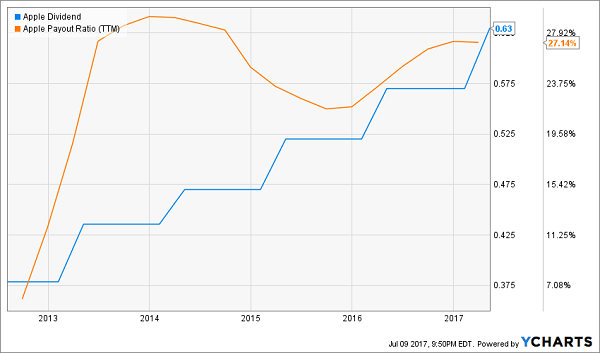
On the dividend front: Apple initiated a regular dividend in 2012 at a split-adjusted 37.9 cents quarterly, and that has since exploded by 66 percent. Sure, the stock only yields 1.8%, but consider that the dividend growth has been matched by a similar run-up in shares to their current perch near all-time highs. And considering that Apple sports a sub-30% payout ratio, there’s all sorts of headroom for that dividend to expand over the next couple of decades.
As for social responsibility, while Steve Jobs made Apple great, it was Tim Cook that made social initiatives a priority in Cupertino, California. By 2014, all of Apple’s American operations were powered by renewable energy, its products consume far less energy than earlier iterations and the company has taken additional steps to make its supply chain more transparent and crack down on human rights violations in the making of its products.
Apple has lined many pockets in its time, and it’s increasingly doing it “the right way.”
Apple (AAPL) Will Be a Dividend Growth Machine for Decades
Dividend Yield: 4.4%
AES Corp (AES) is a standard utility play as far as its substantial dividend is concerned, though it’s far more global in scale than most traditional utility holdings. Whereas many sector stocks are plays on various U.S. regions, AES operates across six regions – the United States; Europe; Asia; Brazil; the Andes; and Mexico, Central America and the Caribbean. All told, it spans some 17 countries.
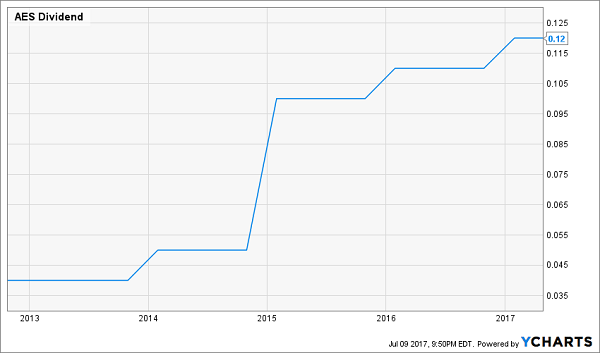
AES is a relatively young dividend payer; it commenced regular payouts in late 2012, though that quarterly check has jumped by leaps and bounds. The 12-cent quarterly dividend is now triple that first 2012 payout.
AES’ qualifications for this list include a strategy to bring global carbon emissions down by 20% to 30% from 2012 through 2018 – a strategy that’s already yielding double-digit results. The company also generates nearly a quarter of its energy via renewable power sources.
AES’ Dividend Is One of the Fastest Growers Among Utilities
Dividend Yield: 4.4%
Host Hotels & Resorts (HST) is a real estate investment trust that’s perfect for the current market environment thanks to its strong positioning that should allow it to easily raise rates to compensate for any additional interest-rate hikes from the Federal Reserve.
That positioning comes from its luxury-centric portfolio that includes resorts and destination hotels – Hyatt Regencies, Marriott resorts and spas, Ritz-Carltons and Westins – you know, the kinds of hotels whose clientele won’t balk when room rates go up by a few bucks every few months.
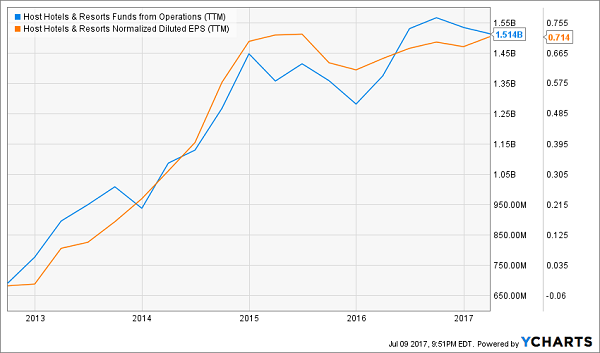
HST aggressively raised dividends until 2014, when it started a new practice of keeping a substantial regular payout then tacking on special dividends at the end of the year. So as long as business is humming, you’re likely looking at an annual payout that’s closer to 5% than 4%.
Host Hotels has a number of social and environmental responsibility initiatives, including community investment, charities, community service, and reducing energy use and water consumption across its portfolio by double digits since 2008.
Host Hotels (HST) Runs a Tight Ship
Dividend Yield: 4.8%
Welltower (HCN), previously Health Care REIT until a name change in 2015, is one of the largest healthcare-minded REITs, investing in several types of properties within the space. HCN is a play on the baby boomers via its senior housing – it was an early player in this business, but is rapidly expanding its portfolio here – while also boasting post-acute care (illness or surgery rehab) facilities as well as outpatient medical centers.
I also like this play because it’s moving more into “private pay” assets, which are much more stable than those reliant on subsidized payers.
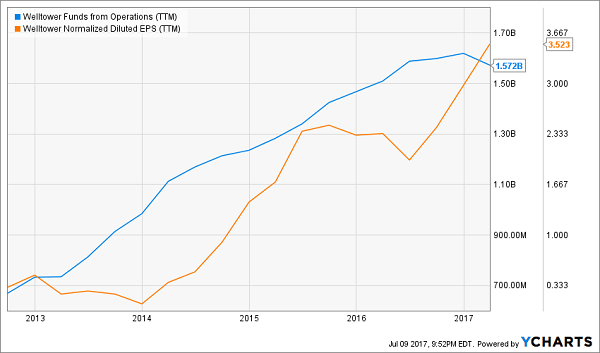
HCN has improved its payout on an annual basis for decades, and it’s pushing back toward the upper part of a range mostly between $60 and $80 from the past few years. Meanwhile, the dividend is well-funded, sitting at around 80% of funds from operations over the past few quarters.
Welltower not only maintains environmental sustainability targets, but also acts to “eradicate the risk of modern slavery and human trafficking” per a 2015 U.K. act.
Welltower (HCN) Will Pay You Without Breaking a Sweat
Dividend Yield: 6.4%
Iron Mountain (IRM) is a particularly interesting REIT to me because of its spot at the intersection of technology, old-school security and real estate.
Iron Mountain was built upon legacy storage and security services such as physical records storage, business solutions and even corporate-grade shredding. That business might be going away over time, but not as quickly as you’d think.
The growth prospects come from the data side, including “Iron Cloud” cloud-based off-site storage, recovery services, data security and even federal government-tailored data management services. That explosive side of the business has helped IRM just more than double its dividend since 2013 to its current 55-cent payout, good for a yield of more than 6% at current prices.
Despite its growing datacenter arm, Iron Mountain is dedicated toward reducing energy use in its facilities, using more renewable energy to power its operations and reinvesting in its communities. Those and other initiatives give IRM the bishops’ green light.
Source : Brett Owen
- The Church of Jesus Christ of Latter-day Saints' added Tesla stock and trimmed legacy automakers like Ford and General Motors last quarter.
- Ensign Peak Advisors is the equity arm of the Church and holds $52 billion in US stocks.
- These are the top changes the investment fund made in the fourth quarter, according to its 13F.
The Church of Jesus Christ of Latter-day Saints' $52 billion investment fund trimmed its stake in legacy automakers like Fordand General Motors while continuing to add to its Tesla position last quarter, according to its latest quarterly 13F filing.
Ensign Peak Advisors is the equity arm of the Church's investment fund and owned about $52 billion worth of stocks as of December 31. The fund saw its assets jump about $4 billion since the third quarter of 2021, and initiated more than 400 new positions in the fourth quarter.
The more than 50-year old fund has relied on donations from its over 16 million members to build up its investment portfolio, which totals more than $100 billion when including its timberland and hedge fund holdings, according to The Wall Street Journal.
The portfolio owns thousands of stocks, and its top holdings show little difference from the S&P 500, with Apple, Microsoft, Alphabet, and Amazon among its largest positions. But the fund is active, with stocks in the tobacco and alcohol sectors excluded from the portfolio.
Some of the stocks owned by the Church, aside from Tesla, are also held by Cathie Wood's Ark Invest. Ensign Peak Advisors added more shares to its Zoom Video stake, initiated a new stake in Ginkgo Bioworks, and partially reduced its stake in Teladoc.
These are the top changes Ensign Peak Advisors made in the fourth quarter, according to its 13F filing made with the SEC.
1. Added to Tesla
Market Value: $755.6 million
Change in Shares: +118,380 (+19%)
Estimated Average Price Paid: $715.21
Ensign Peak Advisors is the equity arm of the Church's investment fund and owned about $52 billion worth of stocks as of December 31. The fund saw its assets jump about $4 billion since the third quarter of 2021, and initiated more than 400 new positions in the fourth quarter.
The more than 50-year old fund has relied on donations from its over 16 million members to build up its investment portfolio, which totals more than $100 billion when including its timberland and hedge fund holdings, according to The Wall Street Journal.
The portfolio owns thousands of stocks, and its top holdings show little difference from the S&P 500, with Apple, Microsoft, Alphabet, and Amazon among its largest positions. But the fund is active, with stocks in the tobacco and alcohol sectors excluded from the portfolio.
Some of the stocks owned by the Church, aside from Tesla, are also held by Cathie Wood's Ark Invest. Ensign Peak Advisors added more shares to its Zoom Video stake, initiated a new stake in Ginkgo Bioworks, and partially reduced its stake in Teladoc.
These are the top changes Ensign Peak Advisors made in the fourth quarter, according to its 13F filing made with the SEC.
1. Added to Tesla Market Value: $755.6 million Change in Shares: +118,380 (+19%) Estimated Average Price Paid: $715.21 Tesla SuperCharger Associated Press
2. Trimmed Ford Market Value: $105.2 million Change in Shares: -7.9 million (-60%) Estimated Average Price Paid: $11.78 The 2022 Ford Bronco Everglades. The 2022 Ford Bronco Everglades. Ford
3. Trimmed General Motors Market Value: $177.6 million Change in Shares: -2.5 million (-44%) Estimated Average Price Paid: $46.21 2021 Chevrolet Silverado pickup truck. 2021 Chevrolet Silverado. Chevrolet
4. Added Pfizer Market Value: $395.6 million Change in Shares: +1.8 million (+20%) Estimated Average Price Paid: $42.34 Pfizer logo Carlo Allegri/Reuters 5. Added Procter & Gamble Market Value: $392.3 million Change in Shares: +586,360 (+32%) Estimated Average Price Paid: $134.64 Tide detergent on supermarket shelves. Proctor and Gamble makes Tide detergent. Joe Raedle/Getty Images
6. Trimmed AT&T Market Value: $64.2 million Change in Shares: -9.9 million (-79%) Estimated Average Price Paid: $31.18 at&t store Justin Sullivan/Getty Images
7. Bought Ginkgo Bioworks Market Value: $31.1 million Change in Shares: New Position Estimated Average Price Paid: $8.38 Ginkgo Bioworks founders Ginkgo Bioworks CEO Jason Kelly, center, with his fellow company founders. Ginkgo Bioworks
How to Invest in Stocks: A Beginner’s Guide
Investing is a time-tested way of putting your money to work for you, as you work to earn more of it. Legendary investor Warren Buffett defined investing as “forgoing consumption now in order to have the ability to consume more at a later date.”1
By investing your money regularly, you may be able to increase it many times over with time. That's why it's important to begin investing as early as possible and as soon as you have some money saved for that purpose. Furthermore, the stock market is a good place to start.
Whether you have $1,000 set aside or can manage only an extra $25 a week, you can get started. Bear in mind that there's a lot that you can and should learn about investing in stocks to achieve financial success. However, right now, read on for the steps to begin the process.
KEY TAKEAWAYS
- Investing is the act of committing money or capital to an endeavor with the expectation of obtaining additional income or profit.
- Unlike consuming, investing puts money to work so it can grow over time.
- However, investing also comes with the risk of losses.
- The stock market is a common way for investors, no matter their experience, to invest for a lifetime.
- Beginning investors can get help from expert advisors, leave their portfolio selection and management to robo-advisors, or take a DIY approach to investing in stocks,
Click Play to Learn How to Start Investing in Stocks
Steps to Get Started
1. Define Your Tolerance for Risk
What's your tolerance for risk (the chance that you may lose money while investing)? Stocks are categorized in various ways, such as large capitalizationstocks, small cap stocks, aggressive growth stocks, and value stocks. They all have different levels of risk. Once you determine your risk tolerance, you can set your investment sights on the stocks that complement it.
2. Decide on Your Investment Goals
You should also determine your investment goals. When opening a brokerage account, an online broker such as Charles Schwab or Fidelity will ask you about your investment goals (and the aforementioned level of risk that you’re willing to take).
- If you're just beginning your career, an investment goal could be to increase the amount of money in your account. If you're older, you may want to generate income as well as grow and protect your wealth.
- Your investment goals might include buying a house, funding your retirement, or saving for tuition. Goals can change over time. Just make sure that you define and review them periodically so that you can keep your focus on achieving them.
3. Determine Your Investing Style
Some investors want to take an active hand in managing their investments, while others prefer to set it and forget it. Your preference may change, but decide on an approach to get started.
- If you're confident about your investing knowledge and capability, you could manage your investing and portfolio on your own. Traditional online brokers, like the two mentioned above, allow you to invest in stocks, bonds, exchange-traded funds (ETFs), index funds, and mutual funds.
- An experienced broker or financial advisor can help you make your investment decisions, monitor your portfolio, and make changes to it. This is a good option for beginners who understand the importance of investing but may want an expert to help them do it.
- A robo-advisor is an automated, hands-off option that typically costs less than working with a broker or financial advisor. Once a robo-advisor program has your goals, risk tolerance level, and other details, it automatically invests for you.
4. Choose Your Investment Account
Retirement plan at work: You can invest in various stock and bond mutual funds and target-date funds through a retirement plan at work, such as a 401(k), if your employer offers one. It may also offer the option of investing in the employer's company stock.
Once you enroll in a plan, contributions are made automatically at a level you set. Employers may make matching contributions on your behalf. Your contributions are tax deductible and your account balance grows tax deferred. This is a great way to maximize your investing dollars with little effort. It can also instill in investors the discipline of regular investing.
An IRA or taxable account at a brokerage: You can also start investing in stocks by opening an individual retirement account (even in addition to having a workplace plan). Or, you can go with a regular, taxable brokerage account. Normally, you'll have lots of options for investing in stocks. These could include individual stocks, stock mutual funds and exchange traded funds (ETFs), stock options.
A robo-advisor account: As referenced above, this type of account takes your investment goals and creates a stock portfolio for you.
5. Learn to Diversify and Reduce Risk
Diversification is an important investment concept to understand. In a nutshell, by investing in a range of assets, or diversifying, you reduce the risk that one investment’s performance can severely hurt the return of your overall investment portfolio. You could think of it as financial jargon for not putting all of your eggs in one basket.
It can be difficult to diversify when investing in individual stocks if your budget is limited. For example, with just $1,000, you may only be able to invest in one or two companies. This results in greater risk.
This is where mutual funds and ETFs can help. Both types of funds tend to own a large number of stocks and other investments. This makes them a more diversified option than a single stock.
Minimums to Open an Account
Many financial institutions have minimum deposit requirements. In other words, they won’t accept your account application unless you deposit a certain amount of money.
It pays to shop around, and not just to find out minimum deposits. Check out our broker reviews (see below). Some firms don't require minimum deposits. Others may reduce costs, such as trading fees and account management fees if you have a balance above a certain threshold. Still others may offer a certain number of commission-free trades for opening an account.
The Costs to Invest in Stocks
Commissions and Fees
As economists like to say, there's no free lunch. All brokers have to make money from their customers in one way or another.
In most cases, your broker will charge a commission every time that you trade stocks, whether you buy or sell. Trading fees range from $2 per trade to as high as $10. Some brokers charge no trade commissions at all, but they make up for it with other fees.
Depending on how often you trade, these fees can add up, affect your portfolio's return, and deplete the amount of money you have to invest.
Here's an example:
Imagine that you decide to buy one share of stock in each of five companies with your $1,000. Assuming a transaction fee of $10, you will incur $50 in trading costs which is equivalent to five percent of your $1,000.
Should you sell these stocks, the round trip (the act of buying and then selling) would cost you a total of $100, or 10 percent of your initial deposit amount of $1,000. These costs alone can eat into your account balance before your investments even have a chance to earn a positive return.
Mutual Fund Loads
Mutual funds are professionally managed pools of investor funds that focus their investments in different markets.
They have various fees that you should be aware of. One of these is the management expense ratio (MER). The MER is the fee paid by shareholders of a mutual fund (or ETF) and goes toward the expenses of running a fund.
It’s based on the total of a fund's assets under management. The MER can range from 0.05 percent to 2 percent annually. Bear in mind that, the higher the MER, the more it impacts the fund's overall return.
You may also see sales charges called loads. These include front-end loads and back-end loads. Be sure you understand whether a fund carries a sales load prior to buying it. Check out your broker's list of no-load funds and no-transaction-fee funds to avoid these charges.
For the beginning investor, mutual fund fees may be more palatable compared to the commissions charged when you buy individual stocks. Plus, you can invest less to get started with a fund than you’d probably pay to invest in individual stocks.
By the way, investing small amounts consistently over time in a mutual fund can give you the benefits of dollar cost averaging (DCA) by reducing the impact of volatility.
Online Brokers
Brokers are either full-service or discount.
Full-Service Brokers
Full-service brokers, as the name implies, offer a full range of traditional brokerage services, including financial advice for college planning, retirement planning, estate planning, and for other life events and opportunities. This custom-tailored advice justifies the higher fees that they typically charge, compared to other brokers. These can include a percentage of your transactions, a percentage of your assets under management, and sometimes, a yearly membership fee. Minimum account sizes can start at $25,000.
Discount Brokers
Discount brokers used to be the exception but are now the norm. They offer you tools to select your investments and place your orders. Some also offer a set-it-and-forget-it robo-advisory service (more below). Many provide educational materials on their sites and mobile apps, which can be helpful for beginning investors.
Some brokers have no (or very low) minimum deposit restrictions. However, they may have other requirements and fees. Be sure to check on both of these as you look for a brokerage account that meets your stock investing needs.
We recommend the best products through an independent review process, and advertisers do not influence our picks. We may receive compensation if you visit partners we recommend. Read our advertiser disclosure for more info.
Robo-Advisors
After the 2008 financial crisis, a new breed of investment advisor was born: the robo-advisor. Jon Stein and Eli Broverman of Betterment are often credited as the first in the space.23 Their mission was to use technology to lower costs for investors and streamline investment advice.
Since Betterment launched, other robo-first companies have been founded. Established online brokers such as Charles Schwab have added robo-like advisory services. According to a report by Charles Schwab, 58% of Americans say they will use some sort of robo-advice by 2025.4
If you want an algorithm to make investment decisions for you, including for tax-loss harvesting and rebalancing, a robo-advisor may be for you. What's more, the success of index investing has shown that if your goal is long-term wealth building, a robo-advisor may fit your style.
If you plan to trade frequently, check out our list of brokers for cost-conscious traders.
Stock Market Simulators
People new to investing who wish to gain experience investing without risking their money in the process may find that a stock market simulator is a valuable tool. There are a wide variety of trading simulators available, including those with and without fees. Investopedia's simulator is entirely free to use.
Stock market simulators offer users imaginary, virtual money to invest in a portfolio of stocks, options, ETFs, or other securities. These simulators typically track price movements of investments and, depending on the simulator, other notable considerations such as trading fees or dividend payouts.
Investors make virtual trades as if they were investing with real money. Through this process, simulator users have the opportunity to learn about investing—and to experience the consequences of their virtual investment decisions—without putting their own money on the line. Some simulators even allow users to compete against other participants, providing an additional incentive to invest thoughtfully.
Find out what a hypothetical investment would be worth today.
 TSLA
TSLA AAPL
AAPL NKE
NKE AMZN
AMZN WMT
WMTWhat Is the Difference Between a Full-Service and a Discount Broker?
Full-service brokers provide a broad array of financial services, including financial advice for retirement, healthcare, education, and more. They can also offer a host of investment products and educational resources. They have traditionally catered to high-net-worth individuals and often require significant investments. Discount brokers have much lower thresholds for access, but tend to offer a more streamlined set of services. Discount brokers allow users to place individual trades. They also offer educational tools.
What Are the Risks of Investing?
Investing is a commitment of resources now toward a future financial goal. There are many levels of risk, with certain asset classes and investment products inherently much riskier than others. All investing comes with some degree of risk. It is always possible that the value of your investment will not increase over time. For this reason, a key consideration for investors is how to manage their risk in order to achieve their financial goals, whether these goals are short- or long-term.
How Do Commissions and Fees Work?
Most brokers charge customers a commission for every trade. These fees can go up to about $10 per trade. Due to commission costs, investors generally find it prudent to limit the total number of trades that they make to avoid spending extra money on fees. Certain other types of investments, such as exchange-traded funds, carry fees in order to cover the costs of fund management.
The Bottom Line
If you're just starting out as an investor, it's possible to invest in stocks with a relatively small amount of money. You'll have to do your homework to determine your investment goals, your risk tolerance, and the costs associated with investing in stocks and mutual funds. You should also investigate various brokers to clarify the particular requirements of each and which may best fit your needs.
Once you do, you’ll be well positioned to take advantage of the substantial potential that stocks have to reward you financially throughout the years.
*See important disclosures


No comments:
Post a Comment